


Introduction
Choosing the right virtual desktop solution can make or break your remote work strategy, but how do you pick between Azure Virtual Desktop (AVD) and Windows 365 (W365)?
If you've ever wondered which platform offers better scalability, flexibility and cost-efficiency, you're not alone. Both AVD and W365 are powerful Microsoft solutions, but they're designed for different business needs. Whether you're an IT Managed Service Provider, internal team, or simply curious about modern cloud desktops; understanding the real differences can save you time, money and headaches.
In this post, we'll unpack the key features, management options, costs and user experiences with both solutions. By the end, you'll know exactly which one aligns with your organisation's goals and your customers' needs!
Let's dive in 🤿
AVD Overview
Azure Virtual Desktop (AVD) is a powerful virtualisation service that lets you deploy and manage virtual desktops and remote applications, all within the Azure cloud.
With AVD, you can create a scalable, secure and flexible virtual desktop environment that grows with your business and meets evolving user needs.
Want to dive deeper in how AVD works? Check out my Building Blocks of AVD blog post for a full breakdown of its core components.
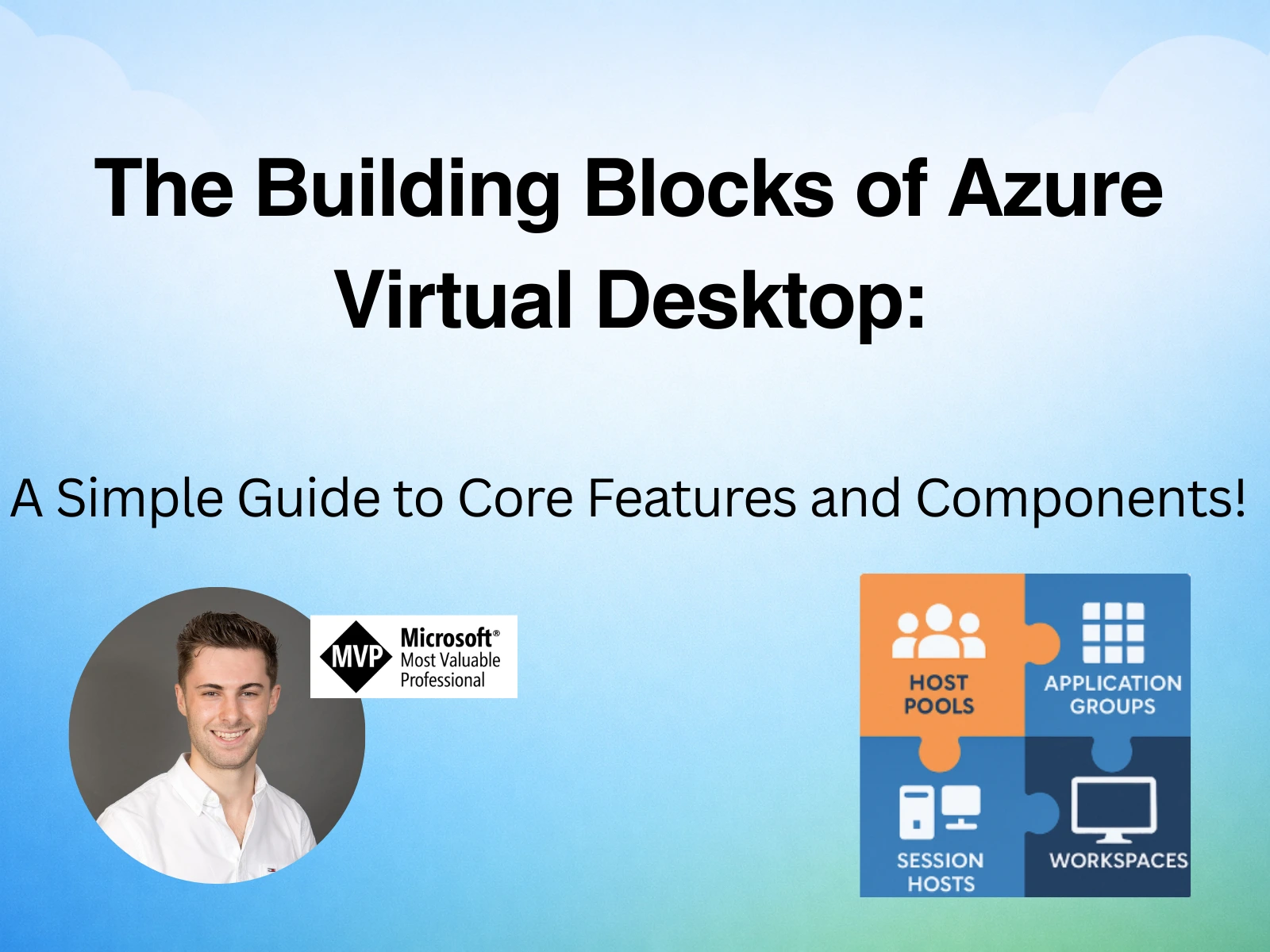 The Building Blocks of Azure Virtual Desktop: A Simple Guide to Core Features and Components!Read article
Windows 365 Overview
Windows 365 (W365) is a cloud-based service that delivers a simple, streamlined virtual desktop experience, designed to make Cloud PCs accessible to everyone; without complex setup or management.
It comes in two editions to fit different business needs:
- Windows 365 Business - perfect for small businesses, offering easy setup and minimal management so you can get up and running quickly.
- Windows 365 Enterprise - built for larger organisations, giving IT teams greater control, advanced security and seamless integration with existing infrastructure.
With Windows 365, you get a consistent and secure Cloud PC experience that's easy to manage, scale and access from anywhere - backed by the power of Microsoft's Cloud.
Single Session vs. Multi Session: What’s the Difference?
When deciding between AVD and W365, one of the most important factors to consider is whether you need single-session or multi-session desktops; and how that impacts cost, flexibility and user-experience.
🖥️ Single-Session - Windows 365 operates exclusively in a single-session mode, meaning each Cloud PC is dedicated to one user. This setup delivers a personalised, consistent experience, just like using a traditional physical PC. This makes it simpler to manage and is ideal for end-users who need their own dedicated environment.
🖥️ 🖥️ Multi-Session - AVD offers multi-session capabilities, allowing multiple users to share the same virtual machine (VM) at the same time. This maximises resource utilisation and can be cost-effective; making a great choice for task workers, seasonal staff or environments where users don't need a dedicated, personal desktop.
Note
AVD also supports personal (single-session) desktops, where each VM is assigned to a specific user; much like W365. However, running AVD as personal desktops often involves higher costs and more management overhead compared to W365.
End User Experience: What It’s Like to Work on AVD vs. Windows 365
When it comes to end-user experience, both AVD and W365 deliver robust, secure and remote-friendly solutions; but they cater to different user needs and business scenarios.
| Feature | Windows 365 | Azure Virtual Desktop |
|---|---|---|
| Consistent Experience | Dedicated Cloud PC for each userPersonalised and stable environmentFamiliar experience, like a physical PC | Offers full desktop or individual RemoteAppsProvides only apps users need or desktop as requiredFlexible to match specific user scenarios |
| Setup & Management | Simple setup with minimal managementFast onboarding of new usersLow IT involvement and overhead | Supports multiple users per virtual machine (multi-session)Optimises resource usage and reduces costsSuited for teams, task workers, or shared environments |
| Accessibility & Customisation | Access from any device, anywhereConsistent performance for remote and hybrid workAlways-on, dedicated Cloud PC experience | Deep integration with Azure servicesHighly customisable to meet specific business needsFlexible configurations for evolving requirements |
🍕 Key Takeaways
- Choose Windows 365 if you want a simple, consistent Cloud PC experience for each user with minimal IT involvement.
- Choose Azure Virtual Desktop if you need flexibility, shared resources, and deeper customisation to align with specific business needs.
Management and Features: Face Off
| Feature | Windows 365 Business | Windows 365 Enterprise | Azure Virtual Desktop (AVD) |
|---|---|---|---|
| VNET Integration | No | Yes | Yes |
| Intune Management | Yes | Yes | Yes |
| Custom OS Images | No | Yes | Yes |
| FSLogix Profiles | No | No | Yes |
| AD DS Support | No | Yes | Yes |
| Multi-Session | No | No | Yes |
| Remote Apps | No | No | Yes |
| MSIX App-attach | No | No | Yes |
Looking at the table above, Windows 365 Business offers the simplest option with minimal management but limited flexibility. Windows 365 Enterprise adds more control, such as VNET integration and custom images, but still keeps management light. If you need full flexibility and advanced features like multi-session, FSLogix profiles, and Remote Apps, Azure Virtual Desktop (AVD) is the way to go, though it requires a more hands-on approach.
Cost
Based on my experience working across a range of AVD environments. I've found that a balanced configuration for around 10 users typically includes 8 vCPUs and 64 GB of memory. This setup works well for standard Office and admin tasks, with a few important considerations:
- Routing AVD network traffic over Microsoft's backbone.
- 128 GiB OS Disk (Premium SSD - P10) for performance.
- FSLogix for profile containers, assuming 30 GB per user.
To give you a high-level cost overview, the table below compares the per-user monthly costs for 10 users across Windows 365 Business, Windows 365 Enterprise, and AVD using consistent assumptions for fairness.
For AVD, the comparison is based on a single-session host sized as mentioned above, without Azure Backup (since images are typically used and this setup would avoid unnecessary backup costs). No scaling plan is applied, and a 1-year Azure Savings Plan is assumed to balance flexibility and cost savings.
Pricing is based on the UK South datacenter and reflects rates from the Azure Pricing Calculator (E8s v5) at the time of writing (GBP), but note that pricing is subject to change.
| Solution | Processor | RAM | Storage | Cost (per user/month) |
|---|---|---|---|---|
| Windows 365 Business | 2 vCPU | 8 GB | 128 GB | from £35.60 |
| Windows 365 Enterprise | 2 vCPU | 8 GB | 128 GB | from £35.60 |
| Azure Virtual Desktop for 10 users (AVD) | 8 vCPU | 64 GB | Varies | £29.05 |
📝 Notes:
- AVD cost is based on a shared session host model (multi-session) making it more cost-effective for groups of users.
- Windows 365 costs reflect per-user dedicated Cloud PCs.
- Storage for AVD is variable depending on profile and OS disk consumption.
A Final Thought
While Windows 365 offers predictable pricing with minimal management, AVD can be more cost-effective in multi-session scenarios, but requires more hands-on management and careful configuration to achieve these savings.
Conclusion
Choosing between Azure Virtual Desktop (AVD) and Windows 365 (W365) ultimately comes down to your organisation’s priorities.
- If you’re looking for a fully-managed, easy-to-deploy solution with predictable costs and minimal IT overhead, Windows 365 is a great fit, especially for users who need dedicated desktops.
- If you need greater flexibility, scalability, and cost-efficiency for a larger, dynamic workforce, and are comfortable with more hands-on management; AVD offers unmatched customisation and control.
No matter which path you choose, both solutions enable a modern, secure, and productive virtual desktop experience that supports today’s remote and hybrid workforces.
Comments (0)
No comments yet. Your first commenter will appear here.
Leave a comment
Join the discussion
Become a member of 9to5Azure to start commenting.
Already a member? Sign in